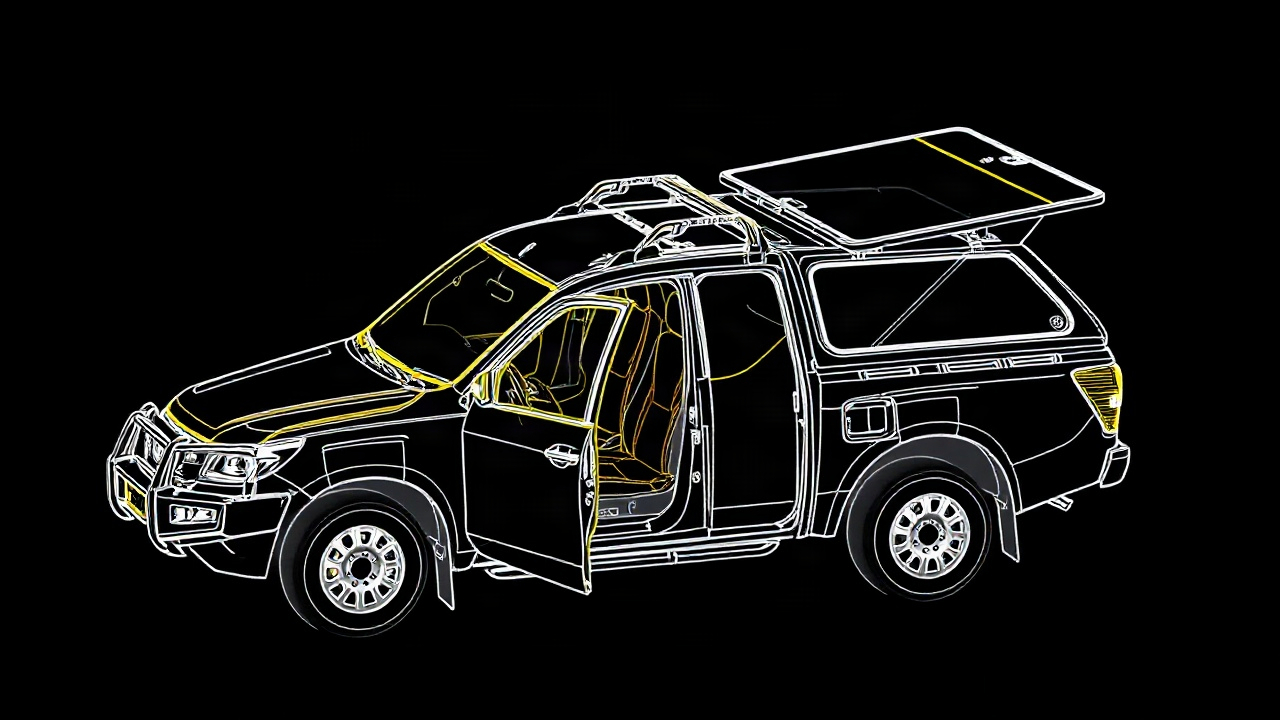
Central locking lets you lock and unlock every door on your canopy or service body in one go, instead of walking around the ute with a key. It is worth it if you open and close the doors many times a day, carry valuable tools, or work on sites where you step away from the ute often. If you only open the canopy a couple of times a week, good keyed T-handle locks are usually enough.
A canopy with three or four lockable doors means three or four keyholes. That is fine on a weekend tourer. On a work ute that gets opened forty times a day, it is the kind of small hassle that leads to doors being left unlocked.
How it works
Each door gets an electric actuator that moves its lock. The actuators are wired to a control unit, which runs off the ute’s power and is triggered by a button, a remote or, on some setups, the vehicle’s own key fob. Press once and every door locks; press again and they all unlock.
The handles and latches on the doors stay the same. Central locking just takes over the job of turning the lock.
Who it suits
- Tradies in and out of the canopy all day. One press instead of a lap of the ute, every time you grab a tool.
- Anyone carrying valuable gear. If locking is easy, it actually gets done, including when you just pop into the servo.
- Fleets. Drivers change, keys get lost. Fewer keys to manage helps.
- Service bodies with several compartments. The more doors you have, the more central locking saves.
For a tourer who opens the canopy at camp and on the drive home, keyed locks do the job well and there is less to go wrong.
What to check before you add it
- Power. The system draws from the ute’s electrics. If you are also running a fridge, lights or a dual-battery setup, plan the wiring together. Our dual-battery and DC-DC charger guide covers the basics.
- A way in without power. Ask what happens with a flat battery or a fault. A key override matters when your tools are inside.
- Weather sealing. Actuators and wiring need to stay dry and dust-free, especially on gravel roads. See our notes on waterproof and dustproof canopies.
- Which doors. You may not need every compartment on the system. Some owners keep one small door on a key for things they rarely open.
- Warranty. Check how the locking system is covered alongside the canopy’s own warranty on locks, struts and seals.
Build it in, don’t bolt it on
Central locking is simplest when it is planned with the canopy: the wiring can run through the frame instead of along it, the door hardware is chosen to suit the actuators, and the power feed is sized from the start.
On UTE HARIO service bodies, central locking is one of the options you can add when you configure the build, along with drawers, water tanks and fitting. Have a look at the 1800mm three-door service body, the HARIO FC-180 jack-off crossdeck canopy, or browse more toolbox and storage guides.
Frequently asked questions
What does central locking on a ute canopy do?
It lets you lock and unlock every canopy or toolbox door at once, usually with a button or remote, instead of turning a key in each lock. The doors still have their own handles and locks.
Can central locking be added to a canopy later?
Sometimes, but it is easier to plan at the build stage, when the wiring path, door hardware and power supply can be worked in. Retrofitting depends on the canopy and the lock hardware already fitted.
Do I still get keys with central locking?
Ask the builder how the system handles a flat battery or a fault. A key override or another manual way in means you are not locked out of your tools if the power goes.
Is central locking available on UTE HARIO bodies?
Central locking is listed as an option on UTE HARIO service bodies, alongside the standard lockable T-handles. Mention it when you get a quote so it is planned into the build.