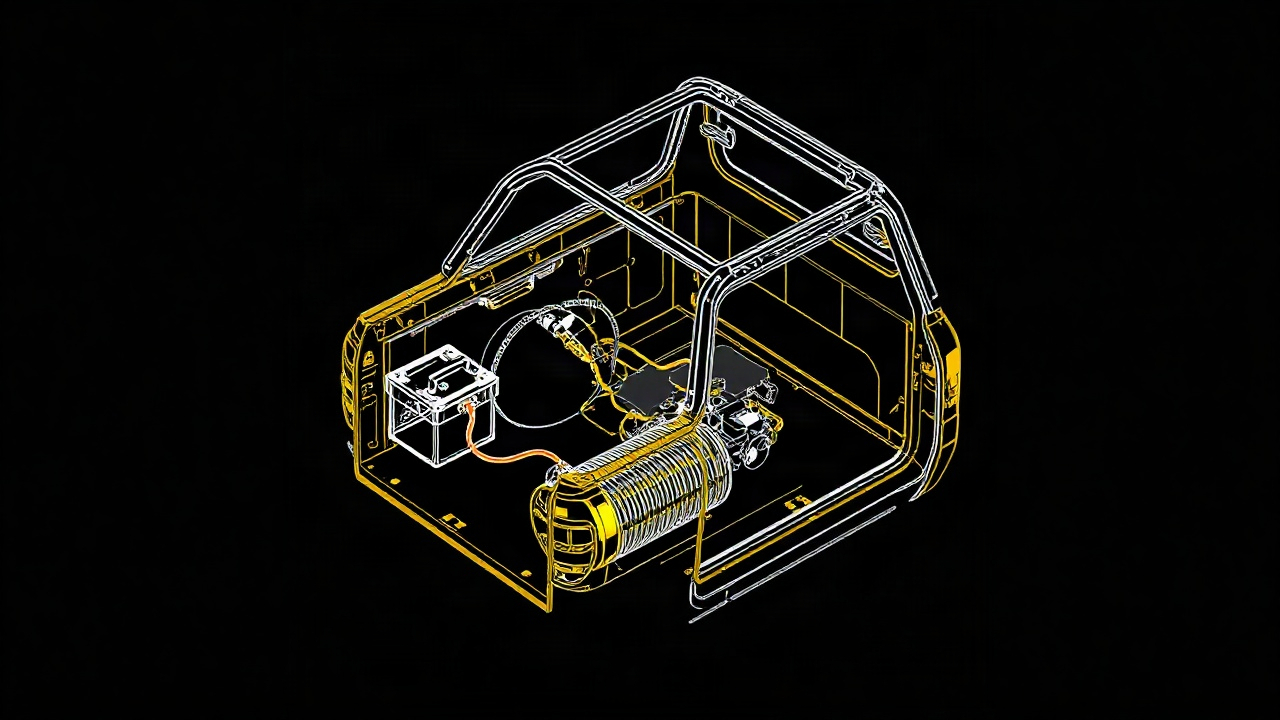
A dual-battery setup keeps your fridge and lights running from an auxiliary battery in the canopy while the starting battery stays reserved for starting the ute. On most utes built in the last decade, that second battery should be charged through a DC-DC charger rather than a simple isolator, because smart alternators don’t supply enough voltage to charge it properly.
Our guide to setting up 12V power in a ute canopy covers the whole system. This one goes into the two parts people ask about most: the second battery and how it gets charged.
How a dual-battery system works
There are two batteries. The starting battery under the bonnet does what it always did. The auxiliary battery, usually in the canopy, runs everything you add: fridge, lights, outlets, water pump.
When the engine is running, the alternator charges both. When the engine is off, the two are kept apart, so you can run the fridge all night and the ute will still start in the morning. That separation is the whole point.
Why modern utes need a DC-DC charger
Older utes had alternators that put out a steady charging voltage, and a voltage-sensing isolator was enough to charge a second battery. Many newer utes use smart alternators that lower their output once the starting battery is full, to save fuel.
That’s fine for the starting battery, but by the time the current reaches a battery at the back of a canopy, the voltage is too low to charge it fully. The battery slowly sulfates (lead-acid) or never reaches full charge, and the fridge cuts out on the second day.
A DC-DC charger fixes this. It takes whatever the vehicle gives it and steps it up to the right charging profile for your auxiliary battery, lithium or AGM. Many also have a solar input, so one unit handles charging from the ute and from a panel.
Sizing the auxiliary battery
Work it out from your own load, not from what a mate runs:
- List every item and roughly how many amp-hours it uses in a day. The fridge is usually the biggest; check its specification or measure it.
- Add them up for a typical day.
- Decide how long you want to go without charging. Tradies who drive every day need less reserve than tourers who stay put for two or three days.
- Allow for usable capacity. Lithium can use most of its rated capacity; lead-acid should only be drawn down to about half if you want it to last.
The charger has to keep up too. A small charger on a big battery takes many hours of driving to refill it, which matters if your trips between jobs are short.
Lithium or AGM
Lithium (LiFePO4) is the default choice for canopy builds now. For the same usable power it weighs roughly half as much as AGM, lasts more charge cycles and holds its voltage better as it drains, so the fridge runs properly until the battery is nearly flat. The trade-off is upfront cost and the need for a charger with a lithium profile.
AGM still works. It costs less and is forgiving, but it’s heavier and you only get about half its rated capacity without shortening its life. Weight matters in a canopy, because everything counts against payload. Our payload guide shows how to check it.
Where it goes in the canopy
- Battery: low, strapped into a box or tray that can’t move under braking, towards the cab end. Shorter cable to the vehicle means less voltage loss.
- DC-DC charger: close to the battery, with airflow around it.
- Cable from the vehicle: sized for the charger’s current and the length of the run, fused at both ends, and protected with grommets where it passes through aluminium.
- Fuse block and monitor: somewhere you can reach and read without unloading the canopy.
Have a licensed auto electrician do the vehicle-side wiring and the charger install. It’s the part where a mistake is expensive.
Plan it into the canopy from the start
Battery boxes, cable entry points and charger mounting are easier to build in than to add later. UTE HARIO canopies are made to order, so tell us what you plan to run when you get a quote and we’ll leave space for it. Start with the HARIO FC-180 jack-off crossdeck canopy, see touring canopy setups, or browse more build and fit-out guides.
Frequently asked questions
Why can’t I just use an isolator for my second battery?
Many recent utes have smart or variable-voltage alternators that drop their output once the starting battery is full. A simple isolator then passes too little voltage to charge an auxiliary battery properly. A DC-DC charger boosts and regulates it so the second battery charges fully while you drive.
How big should the auxiliary battery be?
Add up the daily use of everything it runs, mainly the fridge, then allow for at least a day or two without charging if you camp. Many touring setups end up around 100 to 200 amp-hours of lithium, but your own load list should decide it, not a rule of thumb.
Is lithium worth it over AGM?
For most canopy builds, yes. A lithium (LiFePO4) battery weighs roughly half as much for the same usable capacity and can be drawn down further without damage. It costs more up front and needs a charger with a lithium setting.
Where should the battery and charger go?
Low and as close to the cab end as practical, so cable runs to the vehicle stay short and the weight sits forward. Keep the charger somewhere with airflow, as it gets warm while charging.
Does the dual-battery setup need to be installed by a professional?
The vehicle-side wiring, the DC-DC charger and the main battery cable should be done by a licensed auto electrician. Getting cable size or fusing wrong can cause a fire.