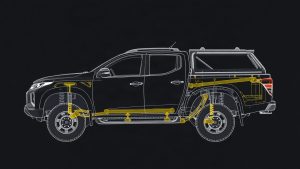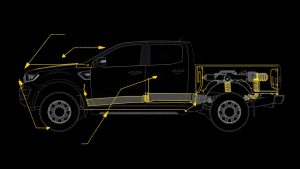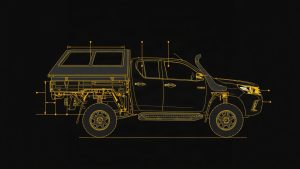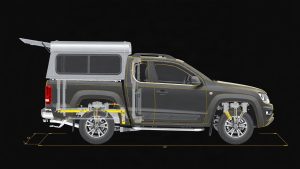
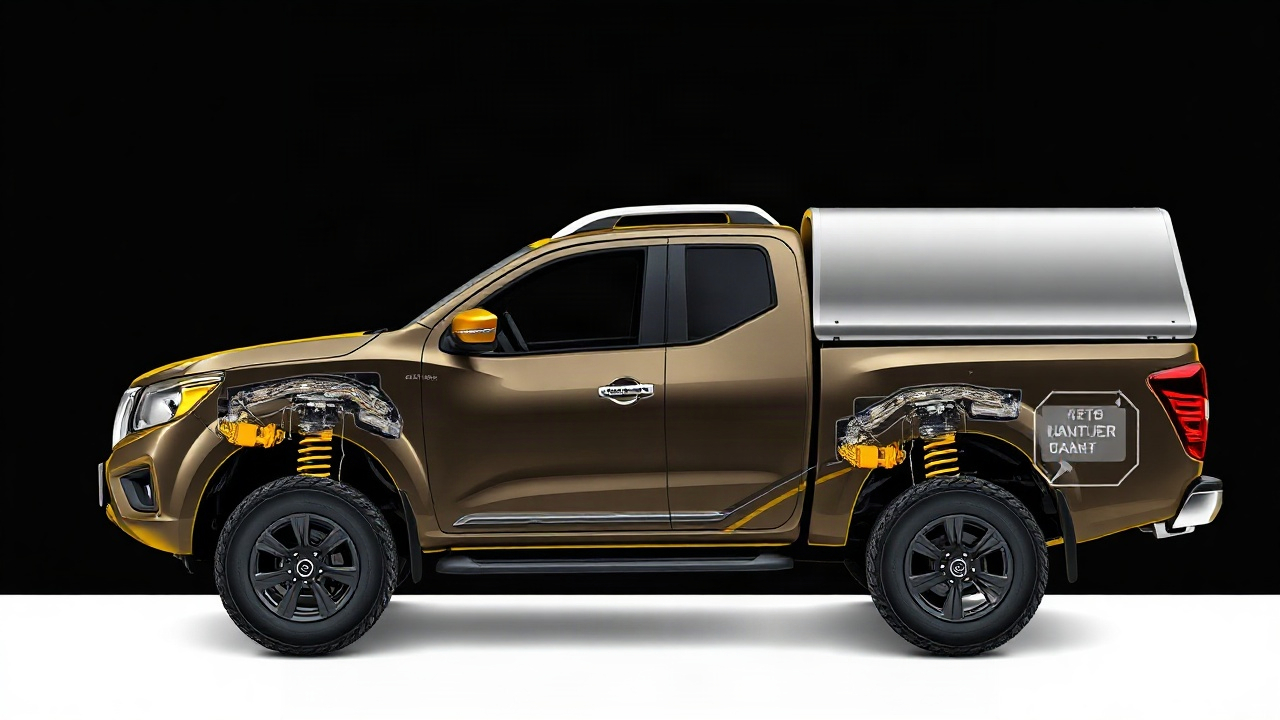
A Nissan Navara takes an aluminium canopy on the factory tub or on an alloy tray that replaces it. Cab style sets the length, the D40 and NP300 do not share tub hardware, and the coil-spring rear suspension is the detail worth planning around — it rides well empty and sags early under a permanent fitout. UTE HARIO measures and builds Navara canopies to order in Melbourne.
Which Navara you have changes the job
Start with two questions: cab style, and whether the tub stays. The Navara has sold as a single cab, a king cab and a dual cab, and the tub length shifts with each one. So does the payload on the door placard.
The generation matters too. The D40 and the NP300 that replaced it have different tub dimensions and different rail shapes, so a tub-mount kit cut for one is not a safe assumption on the other. Tray-mount builds sidestep the issue entirely, because the tray sets the mounting geometry and the body underneath stops being part of the equation.
The coil-spring rear end
This is the part of a Navara build people underestimate. The NP300 runs coil springs at the rear rather than leaves. Empty, it rides better than most utes in the class. Loaded permanently, it settles — and a canopy with drawers, a battery and a fridge in it is a permanent load, not an occasional one.
None of that stops a canopy going on. It just means the suspension conversation belongs in the same quote as the fitout, not six months later when the rear sits low and the headlights point at the trees. Heavier coils suit most working builds; a leaf conversion is the answer when the ute is carrying close to its limit every day.
The practical version: decide the fitout weight first, then sort the springs for that weight. Doing it in the other order means paying twice.
Tub mount or tray mount
A tub-mount canopy sits on a channel across the tub rails and clamps rather than drills. You get sealed, lockable storage for less money, the ute keeps its factory shape, and the canopy lifts off at the end of a lease with nothing to repair.
What you give up is floor space. The wheel arches intrude, the usable width pinches in at drawer height, and the tub sheet metal was never designed to carry a loaded fitout.
Swap the tub for an aluminium tray and the canopy bolts into tray crossmembers instead. The floor runs flat wall to wall, you pick up width and length, and drawers, a fridge slide or a water tank stop fighting each other for room. Most trade and touring Navaras we build go this way.
Length by cab style
Dual cab trays land around 1800 mm on a typical build. That carries a drawer bank, a fridge slide and a real tool load, but every module has to earn its floor — at that length there is no spare space to waste on a layout that looked fine on paper.
King cab trays run longer, which is the sweet spot for a tradie who wants a full canopy and still uses the back of the cabin. Single cabs are longer again, enough for a full-length canopy or a part canopy with open tray behind it for pipe, ladders and timber.
Laying out a Navara canopy
Most Navara fitouts settle into the same shape: drawers low on one side for hand tools and fasteners, shelving above for what you reach standing up, and the long gear along a wall or under the tray. Door swing decides more than the drawer count does — a door that opens into a fence line or a gate is a door you stop using, and you only find that out on site.
If the ute has to switch between jobs, look at our HARIO FC-180 jack-off crossdeck canopy. It jacks off the tray, so the vehicle goes back to a flat deck for a trailer weekend or a tip run instead of being locked into one configuration. The rest of the range is in the shop.
What to send us for a quote
Cab style, year, whether the tub is staying, and what you plan to put inside. If a tray is already fitted, its length and width. Photos of the rear of the vehicle tell us more than a paragraph does. Other fitment write-ups live in our vehicle guides.
Frequently asked questions
What tray length suits a Navara dual cab?
Most dual cab Navara trays come out around 1800 mm, which is enough for a drawer bank, a fridge slide and a working tool load without the canopy overhanging past the tow bar. King cab builds run longer. We measure the vehicle rather than working off a model year, because tow bars, rear steps and where you want the tray to sit relative to the cab all move the number.
Does the Navara’s coil-spring rear end matter for a canopy?
It matters for how you load it, not for whether a canopy fits. The NP300 uses coil springs at the rear instead of leaves, which rides better empty but sags sooner under a constant load. A canopy plus a permanent fitout is a constant load. If the ute is going to carry that weight every day, budget for suspension work at the same time — heavier coils or a leaf conversion — rather than discovering the ride height problem after the build.
Can I fit a canopy without removing the factory tub?
Yes. A tub-mount canopy clamps to a channel laid across the tub rails, so nothing is drilled and it comes off later without leaving damage — the sensible path on a leased or financed ute. The trade-off is the floor: the wheel arches push into the tub at the exact height a drawer wants to sit, so the fitout has to work around them.
Is the older D40 Navara different to fit?
Different tub, different mounting points, and on the D40 the tub dimensions and rail shape do not match the NP300. Tub-mount hardware does not carry across between the two. Tray-mount builds are far less sensitive, because the tray sets the geometry and the body underneath stops mattering.
How much can a Navara carry once the canopy is on?
Read the payload figure off your own door placard — it varies by variant and year — then subtract the tray and canopy before you plan anything else. What is left pays for drawers, a second battery, a fridge, recovery gear and water. Water is the one that catches people: a litre is a kilogram, so a 60-litre tank is a passenger you take everywhere.
Do you build Navara canopies in Melbourne?
Yes. Cutting, folding and welding all happen at our Melbourne factory, so if something does not line up it gets fixed by the people who made the part instead of going back through an importer. Bring the ute in, or send us the cab style, year and tray dimensions and we will start from there.