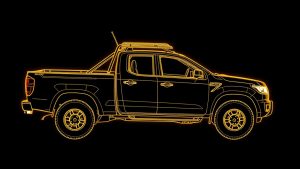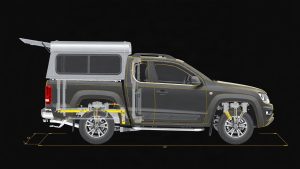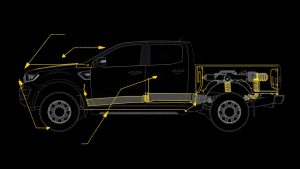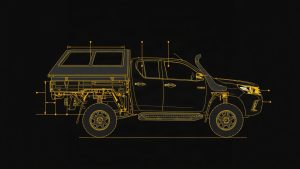
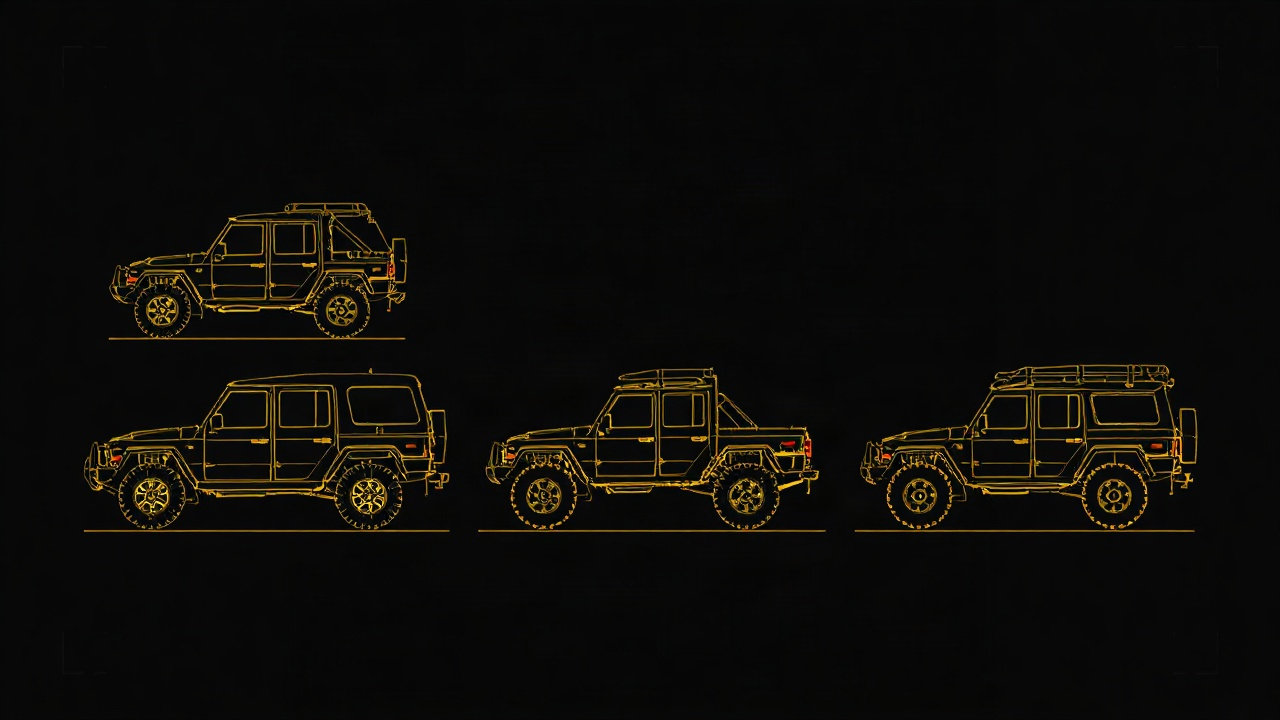
Only one of the three 70 Series bodies takes a canopy the normal way. The 79 is a cab chassis, so it accepts an aluminium tray with a canopy bolted to it. The 76 is a wagon and the 78 a troop carrier, both with fixed bodies and no deck, so their storage goes inside, on the roof and under the chassis. UTE HARIO measures and builds 70 Series fitouts to order in Melbourne.
Three bodies, one chassis
People say “70 Series” as if it were one vehicle. It is a family. The 76 is the short wagon, the 78 is the long troop carrier, and the 79 is the cab chassis ute in single and double cab form. They share a lot underneath and almost nothing where storage is concerned.
That distinction decides your build before anything else does. A canopy needs a flat deck to sit on. Two of these three do not have one.
The 79: the one canopies were made for
Buy a 79 and you get a cab, a chassis and nothing behind it. Whatever goes back there is your decision, which is why the 79 ended up as the default platform for serious work and touring builds in this country.
The sequence is straightforward. An aluminium tray bolts to the chassis, then the canopy mounts to the tray crossmembers. Because the deck is flat wall to wall, drawers, a fridge slide and a water tank can sit alongside each other instead of fighting for the same corner. Our tray and canopy combos article covers how the two parts work as one structure, and the LC-79 build page goes into the matched combo itself.
Cab style is the next decision, and it is about deck length. A single cab gives you more chassis behind the cab and a longer canopy; a double cab trades that for rear seats. We have written about that trade-off in single cab vs dual cab canopies.
The 76 wagon: inside and up top
The 76 has a steel body over the cargo area and it is not coming off. Storage happens in three places: the rear of the cabin, the roof, and under the chassis rails.
Inside, most 76 owners run a drawer system in the back with a flat top for a fridge or a mattress, plus a cargo barrier so nothing joins you in the front on a rough track. Our drawer article applies here, though the module has to be built to the wagon’s floor rather than a tray.
On the roof, a rack takes the long, light and awkward gear: shovels, sand tracks, an awning, swags. See roof racks for what is worth putting up there and what is not. Under the chassis, an undertray box is one of the few ways to add lockable outside storage to a wagon, and it is dead space otherwise. A water tank can go under there too.
The 78 Troop Carrier: more space, same rules
The 78 is the long-wheelbase one with the enclosed body behind the cab, and it has genuine volume back there. Fitouts run to drawers, a full bed platform, shelving down one side and a dual battery setup. It is closer to fitting out a van than a ute.
Some owners do remove the rear body and run a tray on a 78. That works, but it is a cut-and-fabricate project with weight, registration and structural consequences, not a bolt-on canopy fitment. Talk to us before you commit either way.
Weight is the part that bites
Whichever body you are on, work out the load before the build, not after. Write down what is going in: drawers, second battery, fridge, water, recovery gear, tools, and the people who come with you. Read the payload figure off your own door placard, take off the tray, canopy and fitout, and see what is left.
Water is the one that catches people. Every litre is a kilogram, so a 100 litre tank you fill at the last town is 100 kg you did not plan for. If the sums are tight, price suspension into the same job rather than paying labour twice.
If the ute has to change jobs
A 79 that spends weekdays on site and weekends away does not want a canopy that lives there permanently. The HARIO FC-180 jack-off crossdeck canopy lifts off the tray on its own legs, which puts the ute back to a flat deck for a tip run or a load of steel. Everything else we build is in the shop, and the rest of the canopy articles cover materials, doors and options.
What to send us
Model (76, 78 or 79), cab style if it is a 79, whether a tray is already on it, and what you intend to carry. Photos from behind help more than anything. Other vehicles are covered in our vehicle guides.
Frequently asked questions
Can you fit a canopy to a 76 Series wagon?
Not in the usual sense. The 76 is a wagon with a fixed steel body, so there is no deck to mount a canopy on. Storage on a 76 goes inside: drawers in the rear, a fridge slide, a cargo barrier. Outside, you are looking at roof racks and undertray boxes rather than a canopy.
What about the 78 Troop Carrier?
Same answer, more room. The 78 has a long enclosed body behind the cab, so people fit it out internally with drawers, a bed platform and shelving, then add roof storage. Some owners cut the rear body off a 78 and run a tray, but at that point it is a fabrication job, not a canopy fitment.
So the 79 is the one that takes a tray and canopy?
Yes. The 79 leaves the factory as a cab chassis, single or double cab, which is exactly what a tray bolts to. That is why almost every 70 Series canopy build you see online is a 79. Our 79-specific guide is at LandCruiser 79 canopy builds.
Single cab or double cab 79 for a canopy?
A single cab leaves more chassis behind the cab, so the tray and canopy get longer and a bed fits without compromise. A double cab gives you the back seats and a shorter deck. Neither is wrong, but the deck length changes what you can carry, so decide seats first and size the build around that.
What tray length should I order for a 79?
We do not quote a number off the model. Cab style, tow bar and rear step position, and how the tray meets the cab all move the final dimensions, so we measure the vehicle and cut from that. Same with payload: read the placard inside your door rather than a figure off a forum.
Do you build 70 Series canopies in Melbourne?
Yes. Cutting, folding, welding and coating happen at our Melbourne factory, so adjustments are made by the people who built the thing. Send us the model, cab style and what you plan to carry, or bring the vehicle in.